16 personality types: CoreTypes takes Jung's typology further
Every symbol here is a different way of seeing the world. Tap any one.
Start the test right here
How would you explain to a friend why you go to this one café when there are others right down the block?
Free, no sign-up. Takes about 10 minutes.
What you'll get for free
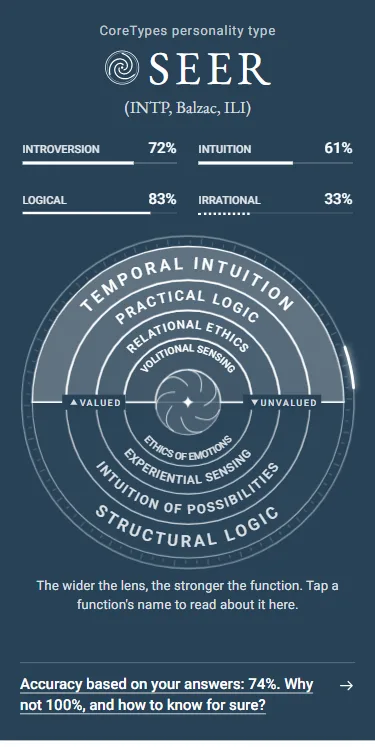
- Your type, percentages on all four scales, and overall accuracy
- Where your thinking runs on its own, and where it could use some help
- Which types you get along with easily, and where friction starts
- A card with your type: send it to friends and see who's who
- Take the Free TestFree
Answer a few questions based on language, not behavior, and get your CoreType in about 10 minutes — completely free.
- Read About Your TypeFree
Head to the CoreTypes gallery, find your result, and read the full profile — how you think, your strengths, and where you tend to struggle.
- Get Professionally TypedFrom $25.00
Want more certainty than a free test can give? Record your answers to the questions and your type is read from your speech, or talk to an expert live.
- Study Your Type With the BooksFrom $10.00
The profile explains you from the inside, the relationship guide pairs your type with all 16, and the Field Guide teaches you to hear types in speech.

“Typology tries to bring order into the chaos of individuality.”
— C.G. Jung, Psychological Types
16 CoreTypes Theory
Not a new test. A new understanding.
Most systems type you by how you act — that’s why they often get it wrong. This model identifies the stable cognitive patterns behind how you interpret reality, leading to far greater accuracy and lasting insight. Learn why this system goes deeper — and how it improves on MBTI and Socionics.
Personality types
Clarity about yourself. Insight into others.
Discover how your mind interprets the world — and how that shapes how others see you. Understanding your type helps you make better choices in work, relationships, and life direction, with clarity that goes far beyond generic personality labels. And by learning about other types, you’ll better navigate compatibility and connection.
Common questions
Your result includes a line, "Accuracy based on your answers," with a percentage. It shows how consistently your answers point to one type, and it varies from person to person. Any test, ours included, gives a version of your type. Speech has the final say: your type is heard in words you didn't choose, and the analysis shows what the answer is built on.
Those tests ask what you usually do and take your word for it. But how people describe themselves shifts with mood and the wish to look good. David Pittenger reviewed MBTI data. Retake the test after five weeks, and up to half of people get a different result on at least one scale. CoreTypes reads your type from the words and phrasing you choose, not from your account of how you behave. Each of our types has the familiar four-letter code, too.
The way you think shows in how you talk: the words you reach for, the topics you bring up unprompted, how you build a sentence. The test checks this on a small scale. You pick the words and phrasing that sound more natural to you, and each pick says something about where your attention goes. The question about the café has no right answer: all four options sound like strengths, just different ones. Thirty-six choices like that add up to a type.
No. An adult's type, read from speech semantics, doesn't change. It's how your mind is wired: which information you notice first and what words you use to talk about it. Over the years your views, habits, job, friends and even your vocabulary change, but the pattern of your speech stays the same. If different tests gave you different types, they were measuring your self-image. That image shifts as life goes on. The type stays put.
Only the cognitive part: where your attention goes on its own, which information you pick up faster, what comes easily to you and what's hard. Character, values, career and habits also grow out of upbringing, surroundings, experience and your own decisions. Your type is linked to them, but it only tilts the odds. That's why our type descriptions say "often" and "tends to" far more than "always."
A type is heard most reliably in free speech, so the answer comes from a recording, not a questionnaire: you answer thirty questions in your own words, and we show in the analysis where in your speech your type came through. Or a live interview with an expert, if you'd rather talk to a person.